 Lower Barriers, Faster Growth, Smarter Real Estate
Many small businesses eventually reach the same turning point.
The garage is full. The spare bedroom has become an office. Inventory is spilling into rented storage units. Vehicles, equipment, materials, and employees are spread across multiple locations.
The business needs a professional place to operate, but a large warehouse, expensive retail storefront, or conventional office lease may not fit its size, budget, or stage of growth.
Flex space helps fill that gap.
By combining warehouse or operational space with a limited office component, flex space gives growing businesses a right-sized environment where they can store inventory, receive deliveries, manage equipment, coordinate employees, and perform administrative work from one location.
For entrepreneurs, flex space can provide a practical next step.
For developers and property owners, these businesses represent one of the most important sources of demand behind the asset class.
What Is Flex Space?
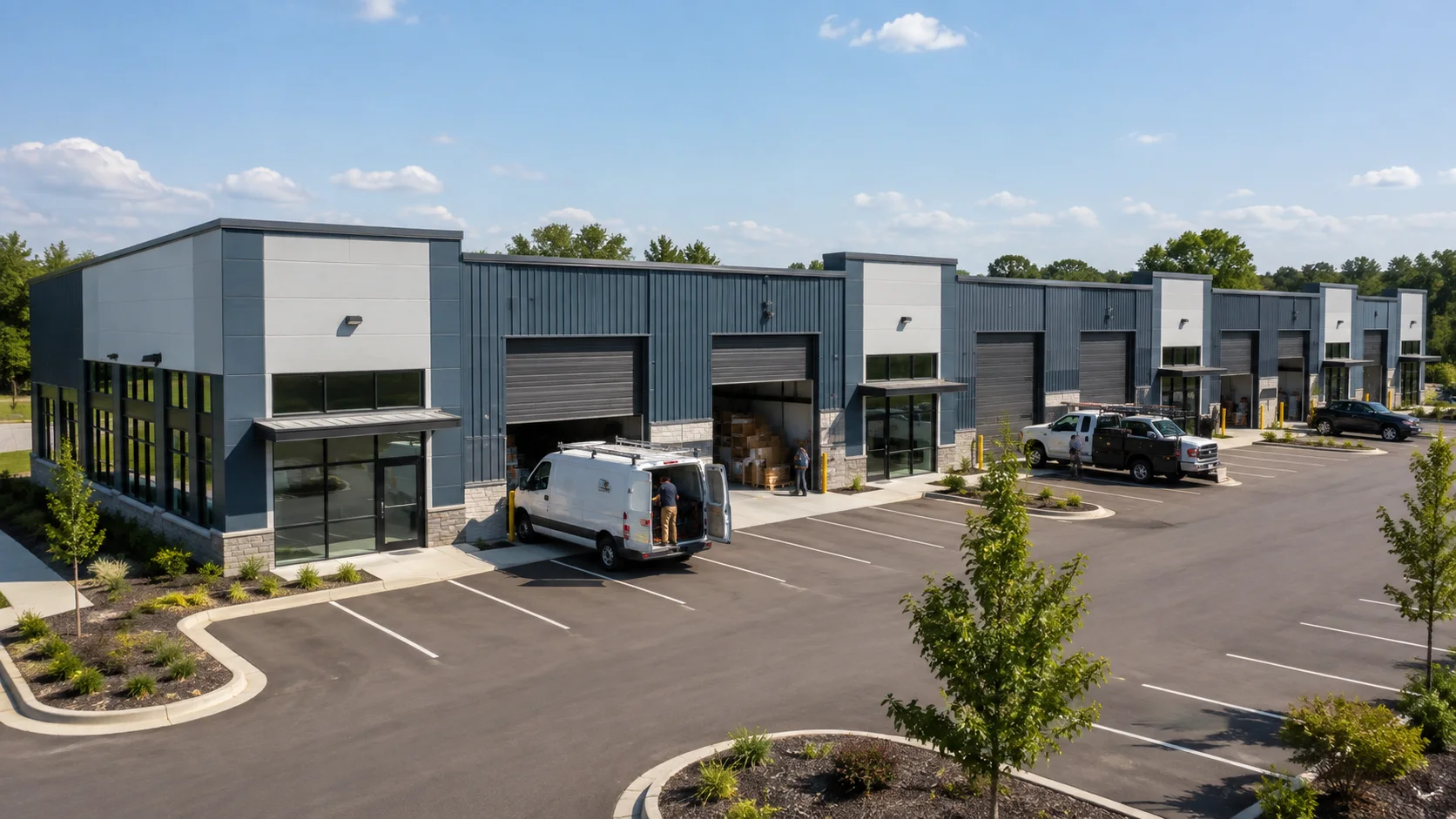
Flex space is a distinct commercial real estate category that combines elements of warehouse, light industrial, storage, and office space in one adaptable unit.
A typical flex space unit may include:
- A drive-in or roll-up door
- Open warehouse or operational space
- A small office or reception area
- A restroom
- Parking for employees and business vehicles
- Access for deliveries, tools, materials, or inventory
The exact configuration varies by property and market. Some units are primarily warehouse space with a small office component. Others include storefront entrances, upgraded facades, additional electrical capacity, climate control, fenced yards, or the ability to combine neighboring bays.
Flex space is sometimes grouped with small bay industrial because the building types may share certain physical characteristics. However, the target tenants, locations, design intent, office ratios, parking needs, and leasing strategies can be very different.
Understanding the distinction between flex space and small bay industrial is important for developers deciding what to build and for businesses deciding what type of property can support their operations.
What makes flex space valuable is not simply how the building looks. It is the building’s ability to support active business operations in a unit size that is practical for a small or growing company.
Why Small Businesses Matter
Small businesses are not a niche part of the American economy.
According to the U.S. Small Business Administration’s Office of Advocacy, the United States has more than 36 million small businesses. They represent 99.9% of U.S. businesses, employ approximately 45.9% of private-sector workers, and generate an estimated 43.5% of gross domestic product.1
These businesses include contractors, service providers, ecommerce companies, distributors, repair businesses, specialty manufacturers, fitness operators, artisans, and local entrepreneurs.
Many need physical space to operate, but their requirements do not align neatly with conventional commercial real estate.
A small contractor may need space for tools, vehicles, materials, and a two-person office—but not a 20,000-square-foot industrial building.
An ecommerce company may need inventory storage, packing stations, and shipping access—but not an expensive retail storefront.
A restoration or service company may need a dispatch location, equipment storage, and room for employees, but need very little traditional office space.
Flex space responds to these needs by giving businesses access to functional commercial space without necessarily requiring them to lease substantially more square footage than they can use.
This is one reason small businesses have become such an important part of the broader flex space market.
The Space Between Self Storage and Traditional Industrial
Many small businesses begin in homes, garages, basements, or storage units. Those locations may work during the earliest stage of the business, but their limitations become more noticeable as operations expand.
A storage unit can hold inventory or equipment, but it may not permit employees, customer visits, assembly, office activities, regular deliveries, or the operation of machinery. A home-based business may also face neighborhood restrictions, limited parking, inadequate storage, or local zoning limitations.
At the other end of the spectrum, conventional industrial space may be too large, too expensive, or too complex for an emerging business.
Flex space creates a bridge between those environments.
It gives businesses access to space that can support actual operations while remaining appropriately sized for their current needs. When properly designed and operated, it can also provide a pathway for tenants to expand into larger units or combine adjoining bays as their businesses grow.
This progression, from a home or storage-based operation into dedicated commercial space, is one of the most important roles flex space can play in a local business ecosystem.
It can also create a natural expansion opportunity for self storage owners whose commercial customers have outgrown traditional storage units.
What Types of Small Businesses Use Flex Space?
The strength of flex space is not tied to one industry. Its value comes from its ability to accommodate a diverse group of local businesses.
Contractors and Skilled Trades
Electricians, plumbers, HVAC companies, landscapers, roofers, remodelers, and general contractors often need a central location for vehicles, tools, materials, equipment, and administrative work.
Drive-in doors, open interiors, and accessible parking can make flex space a practical home base for these businesses.
Ecommerce and Product-Based Businesses
Online retailers may begin with inventory stored in a spare bedroom, garage, or storage unit. As order volume grows, they may need dedicated space for receiving, inventory management, packing, shipping, returns, and light assembly.
This demand is supported by the continued growth of online retail. The U.S. Census Bureau estimated that retail ecommerce sales reached $326.7 billion during the first quarter of 2026, representing a 9.8% increase from the first quarter of 2025. Ecommerce accounted for approximately 16.9% of total retail sales during the quarter.2
Flex space can give growing ecommerce businesses additional operational capacity without requiring them to move immediately into a large warehouse or distribution facility.
Local Service Companies
Cleaning businesses, pest-control companies, restoration firms, pool-service providers, delivery companies, and other mobile service businesses often need more than an office.
They may require space for equipment, supplies, employee coordination, vehicle staging, and dispatch operations. Combining these functions in one unit can simplify day-to-day business activities.
Light Assembly and Production Businesses
Woodworkers, sign companies, cabinet shops, product assemblers, specialty fabricators, and certain small manufacturers may be appropriate flex space users when the property has the necessary zoning, power, ventilation, fire protection, and building systems.
Not every flex space property can support every production use. These businesses must be evaluated based on their specific operations and the capabilities of the building.
Fitness, Recreation, and Studio Uses
Martial arts studios, personal-training facilities, boutique fitness concepts, sports-training businesses, and other recreation-oriented operators may be attracted to open floor plans and large, uninterrupted spaces.
However, these uses can create different parking, occupancy, accessibility, restroom, and life-safety requirements. They should not be treated as automatically compatible with every flex space development.
Creative and Specialty Businesses
Photographers, artists, designers, makers, upholsterers, repair companies, and other specialty businesses may benefit from a space that combines a work area, storage, and a small customer-facing component.
The common denominator is not the industry.
It is the need for functional, adaptable space at a scale that fits a small or growing business.
How Flex Space Can Lower Real Estate Barriers
Flex space does not automatically eliminate the challenges of commercial leasing. Lease terms, deposits, qualification standards, personal guarantees, and tenant-improvement requirements are determined by individual property owners and market conditions.
However, the product can reduce several practical barriers when it is intentionally designed, leased, and operated for small-business tenants.
Right-Sized Units
One of the most significant advantages is the ability to lease a smaller amount of commercial space.
A business that needs 1,500 or 2,000 square feet may struggle to find an appropriate option in a market dominated by much larger industrial buildings. Flex space allows a tenant to lease space that more closely aligns with its operational needs.
Unit sizing should never be based on assumptions alone. A thorough flex space market analysis can help developers understand which business types are active in the market and what unit configurations those tenants are likely to need.
More Manageable Buildout
Units with open interiors, basic office areas, restrooms, and functional building systems may require less customization than traditional retail or office space.
The amount of work required depends on the tenant’s intended use, but a practical starting configuration can shorten the path between signing a lease and beginning operations.
Developers should account for these features early because demising walls, utility services, overhead doors, storefront elements, office components, and tenant-specific improvements can all influence flex space construction costs.
Operational Capability
Flex space is intended to support more than passive storage.
Depending on the property and the permitted use, tenants may be able to receive shipments, park business vehicles, store materials, manage inventory, operate equipment, coordinate employees, and meet customers from the same location.
That ability to combine several business functions is often what allows the tenant to operate more efficiently.
A Path for Incremental Growth
Many small businesses grow gradually rather than moving directly from a garage into a large commercial facility. A multi-unit flex space property can create opportunities for a tenant to move into a larger unit, lease an additional bay, or combine adjacent spaces when those options are available.
That flexibility can benefit the tenant while helping the property retain successful businesses as their space requirements change.
Practical Leasing Strategies
Owners may choose to structure lease terms, deposits, guarantees, and qualification requirements around the realities of smaller business tenants.
This does not mean eliminating appropriate financial screening. It means developing a leasing process that evaluates the business responsibly without assuming that every qualified tenant will have the credit profile or balance sheet of a national corporation.
What Small Businesses Mean for Owners and Developers
For developers, the opportunity is not simply to divide a building into smaller units.
The opportunity is to build around a broad and recurring base of local business demand. A multi-tenant flex space property can reduce dependence on a single large occupant by distributing leased space among multiple businesses. If one tenant vacates, the owner is not necessarily faced with replacing the income from the entire property at once.
That diversification does not eliminate leasing risk. Smaller units can create more individual leases, renewals, tenant relationships, and turnovers to manage.
Performance still depends on:
- Demonstrated local demand
- Appropriate unit sizes
- Competitive rental rates
- Effective property management
- Tenant screening and retention
- Building features aligned with target users
- Adequate parking and site circulation
- Local zoning and use restrictions
- Realistic development and operating costs
A project should be evaluated through a disciplined flex space due-diligence process before the developer commits to the land, building program, or final unit mix. The strength of the model comes from matching the property to the needs of the local business community, not from assuming that any small industrial building will succeed..
Once the project concept is validated, disciplined underwriting remains essential. Creating Sound Financial Projections for Flex Space Acquisitions in 8 Steps outlines a framework for forecasting expenses, income, and risk.
Location, Design, and Zoning Still Matter
The word “flex” does not mean that every use is permitted or that every unit can accommodate every type of tenant.
Each prospective use must be evaluated against the property’s:
- Zoning classification
- Permitted and conditional uses
- Lease restrictions
- Parking supply
- Site circulation
- Utility capacity
- Fire-protection systems
- Accessibility requirements
- Ventilation and mechanical systems
- Occupancy classification
The International Building Code classifies buildings and tenant spaces according to their intended purposes and the hazards associated with those uses. Occupancy classifications influence construction requirements, building limitations, exits, fire-protection systems, and other life-safety provisions.3
For example, a contractor using a unit for equipment storage and office work may have very different requirements from a fitness studio, woodworking shop, automotive business, or assembly operation.
Developers should identify likely tenant profiles early and design the property accordingly. The Flex Space Construction and Zoning Guide provides a more detailed overview of how zoning, building systems, unit configurations, and permitted uses affect development decisions.
The property’s location is equally important. Access, visibility, utilities, surrounding land uses, traffic patterns, local business activity, and proximity to population and employment centers can all influence tenant demand.
Flexibility should be intentional.
It should not be confused with a lack of planning.
Flex Space as Infrastructure for Small-Business Growth
For a small business, moving into dedicated commercial space is a major decision.
It may represent the first time the company hires employees, receives regular freight deliveries, separates its operations from the owner’s home, or establishes a location designed specifically for its work.
Flex space gives these businesses an intermediate step between informal startup space and large-scale commercial occupancy.
It provides room to operate today while creating the potential to grow tomorrow.
For owners and developers, that is the larger opportunity. Small businesses are not simply one possible tenant category. In many markets, they are a central demand driver behind flex space occupancy and long-term performance.
When the location, unit sizes, building design, rental structure, and management approach align with local business needs, flex space can do more than fill a real estate gap.
It can become part of the infrastructure that allows businesses—and the communities around them—to grow.
Explore additional flex space development, construction, investment, and market education through FlexSpace Nation.
Frequently Asked Questions
Why is flex space attractive to small businesses?
Flex space provides a combination of warehouse, operational, storage, and limited office space in units that may be more appropriately sized for small or growing companies. It can allow businesses to consolidate inventory, equipment, vehicles, employees, and administrative functions into one location.
What types of businesses commonly use flex space?
Common users include contractors, skilled trades, ecommerce companies, service providers, distributors, repair businesses, creative companies, and certain light assembly or production users. Fitness, recreation, and customer-intensive uses may also be possible when zoning, parking, occupancy, and building systems support them.
Does flex space always offer shorter leases and lower deposits?
No. Lease terms, deposits, guarantees, and qualification requirements are determined by the individual property owner and local market. Flex space can support practical leasing structures for smaller tenants, but those structures are not guaranteed by the building type.
Can flex space support a business as it grows?
Yes, particularly in properties that offer multiple unit sizes or adjacent bays. A tenant may be able to move into a larger unit, lease additional space, or combine units when space and the building design allow.
Is flex space zoned differently from office or retail property?
Zoning classifications and permitted uses vary by municipality. A flex space development may be located in an industrial, commercial, business-park, or mixed-use zoning district. Each proposed tenant use should be evaluated against local zoning, parking, occupancy, fire, and building-code requirements.
Sources and References
- U.S. Small Business Administration, Office of Advocacy. Frequently Asked Questions About Small Business 2026. February 3, 2026.
- U.S. Census Bureau. Quarterly Retail E-Commerce Sales: First Quarter 2026. May 18, 2026.
- International Code Council. Chapter 3: Occupancy Classification and Use. 2024 International Building Code.
FlexSpace Nation is growing a community of developers, investors, operators facilitating growth and deal flow in the flex space niche